Showing posts with label The Phillips Curve Analysis. Show all posts

Tuesday, September 25, 2018

The Phillips Curve Rides Again

Just when you think the Phillips Curve vanished, it reappears. For those of you who have managed to steer clear of the concept known as the Phillips Curve until now, I would suggest pouring a nice JD over some rocks and watching the grass grow. For those of you who might be even a little curious about this Phillips Curve thing, then read on.

Phillips was one of those New Zealand economists with a lot of initials (A.B.H. aka A.W.H., aka Bill, aka William) before his last name who got famous by noting that there appeared to be a relationship between Ozzie and Harriett – no just kidding – between Ricky and Lucy – just kidding again – between the unemployment rate and wage changes.

This seems innocuous enough, but then real American economists decided to make Phillips even more famous by making the Phillips Curve the truly greatest thing ever in macroeconomics and skateboarding. The first thing they did was replace the wage variable with prices. Thus, they pondered a relationship between the unemployment rate and inflation (the percentage change in prices). I don’t think they got permission from Phillips to make this change but that’s all history now. 

Next they gave the relationship a theoretical foundation. Fancy words – theoretical foundation. The truth is that a monkey with the latest iPhone could have dug up this theory. But sometimes simple things catch on. And they catch on when they support the latest trend in macroeconomics. Recognizing that I am a bit north of my 70th birthday, please understand that when I talk about the latest trends, I am usually referring to the 1960s.

Unlike pink poodle skirts and flat-tops, macroeconomic trends stay around a while. My point today is that the Phillips Curve comes and goes in popularity, but as I was reading the Bible – err I mean the Wall Street Journal – this week it occurred to me that the Phillips Curve had risen from the dead again.

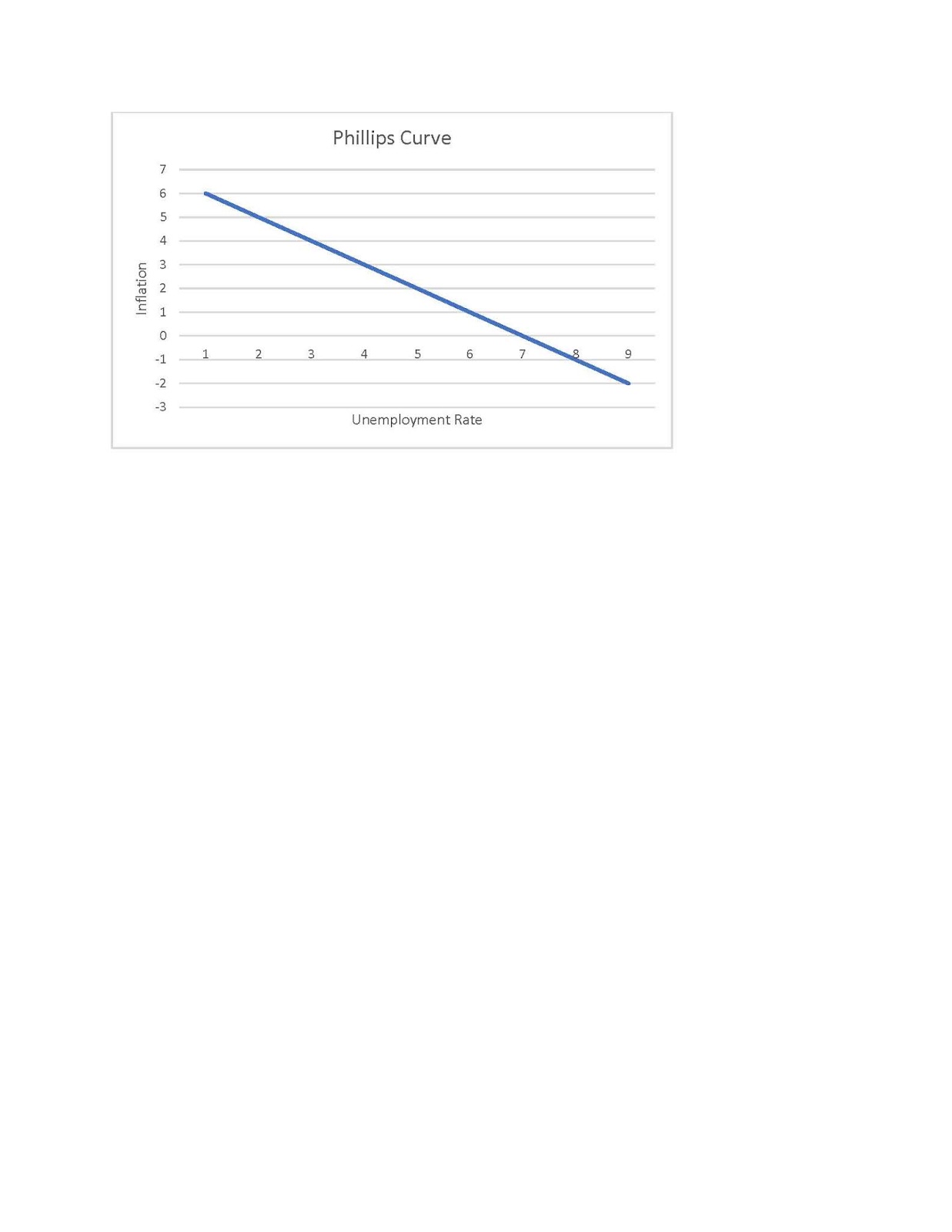
Before I get into those juicy headlines, let’s at least review the basics of the Phillips Curve. Below is a Phillips Curve diagram. The most popular aspect of it is the negative slope that reveals the inverse relationship between inflation and unemployment. Or in more common language, when one of them goes up the other one of them goes down. Sort of like a seesaw.

One might ponder further and say something like, “why?” Why is there a seesaw relationship? The answer comes from short-run macroeconomics and the part of it we call aggregate demand (AD). When households or firms or movie actors decide to buy more stuff, firms get very happy and respond by producing and selling more stuff. To produce more stuff they need more workers and so the unemployment rate goes down. As they hunt for more workers, they raise wages and then they must pass some or all of that wage increase on to their prices. 

Thus when AD increases – unemployment goes down and inflation goes up. Or when AD decreases – unemployment goes up and inflation goes down. Are you seasick from the seesaw yet? That’s basically it. Stay awake Fuzzy.

The big deal is that this little bit of theory is what is behind our love of using monetary and fiscal policy to rev up spending in a flagging economy. Monetary and fiscal policies are designed to pump up AD and therefore save the world from high unemployment – though at a cost of higher inflation.

To get these results, the Phillips Curve is not allowed to move around. It must sit still. Stay Phillips Curve. Stay. Good Phillips Curve. When the Phillips Curve does start to mosey around on the diagram, it messes up the nice seesaw and it ruins the simple world of monetary and fiscal policy. So when the Phillips Curve is jumping to and fro, we forget it exists. But when it sits nicely we take it for a walk.

The last 10 years or so, most economists would rather talk about soccer than Phillips Curves. The unemployment rates around the world went down – but the inflation rate just sat there like a squirrel on Zoloft. That is a sad story for the Phillips Curve. Bad Phillips Curve. 

But all that is changing now. Take Turkey for example. I was going to use Ham instead but we are actually talking about the country, Turkey. The central bank of Turkey recently decided to raise interest rates. And the government got steamed. Why was the government so mad? Because they believe that the rise in interest rates will reduce borrowing for spending and that will cause firms to produce less and fire a lot of workers. Of course, the country would benefit by a slide down the Phillips Curve to lower inflation rates. But the possibility of the higher unemployment rate was too much to risk. Clearly the government of Turkey believes in the Phillips Curve.

Japan is another example of the reincarnation of Phillips. Japan has been bathing in zero or negative inflation for decades. It now seems that inflation is making a comeback – a humble comeback but a comeback nevertheless. So should they be concerned with rising inflation and pull back on stimulus? And risk a rise in the unemployment rate? It's all about Phillips. A decision to curtail inflation will cause higher unemployment if you believe in the stationary seesaw.

It goes without saying that the same discussion is happening in the USA. The Fed has been moving interest rates upward for more than a year now and they plan to keep raising them in 2018 and 2019. A return to normal interest rates, like a return to normal temperatures after sitting in a beer refrigerator for hours, makes sense. But that bit of logic is trampled by the Phillips Curve. The curve was missing in action for 10 years but now all of a sudden it is more popular than a soju in Insadong. Surely if the Fed raises rates a couple more notches, the unemployment rate will rise. Surely if the Fed worries about inflation rising, unemployment will rise.

Okay. Enough about Phillips Curves. Next week I discuss the Davidson Curve. Just kidding again. Who moved my JD?


Tuesday, May 15, 2018

Lesson 22 The Phillips Curve

Below is something called the Phillips Curve. I thought it had expired but I read an article in the Wall Street Journal last week and realized it is back to haunt us. So I am on a mission today.

Like the Laffer Curve, the Phillips Curve is one of those graphical devices named after an economist that is misunderstood and totally abused. Like a good training bra, these curves have their time and place but can easily be misapplied.

I'll save Art Laffer and his curve for another time. A.W. H. Phillips studied wage change and unemployment in the UK from 1861 to 1957. I am not sure why his parents gave him so many initials and that deserves a lot of study, but I won't go into that today either. To make a very long story short, we Americans who wanted to be great again in the 1950s decided to steal Mr. Phillips' curve and apply it to our study of inflation and unemployment in the US.

The result of this study is to think that there might be a stable relationship between inflation and unemployment. Thus we draw the curve with a negative slope and pretend that it sits there until hell freezes over.  For you friends who are not mathematicians, this means that any reductions in the unemployment rate should cause the inflation rate to increase. Or, in other words, when the economy grows rapidly enough to reduce the unemployment rate this puts pressure on markets. Tight labor markets mean that wages rise faster. Tight goods markets mean that prices rise faster. That doesn't sound so crazy, does it?

In our current context in the US, we recently saw the unemployment rate decline to 3.9%. Applying the Phillips Curve means that inflation should be rising. Applying the Phillips Curve to the future means that if the unemployment rate remains low or heads lower -- then surely inflation will rise even more. Again, that doesn't sound so crazy. Of course, we wonder why inflation has not already soared given the tremendous declines in the unemployment rate.

The confusion is that economists are used to models that focus on supply and demand. And while discussions of the Phillips Curve often involve throwing around those words, the Phillips Curve is neither a supply curve nor a demand curve and this drives us crazy. What is it? Basically, it is a useful construct that amalgamates supply and demand but in ways that satisfy only the user. One user says one thing; another user says another.

This lack of consensus arises because we are using this construct as a proxy for an inflation forecasting equation. An inflation forecasting equation stems from a model. This explicit model has two components -- the aggregate demand for goods and services (AD) and the aggregate supply of goods and services (AS). To understand changes in the inflation rate, you must examine all the major things that impact a country's AD and AS. One of those things is the unemployment rate.

Did I underline the word one? I should have. Only one of the zillions of important things that impact inflation is the unemployment rate. Don't get me started because a zillion is a lot of things to discuss. But consider some of the important ones. Oil prices are starting to rise again these days. Might that impact inflation in the USA? What about when prices of mobile phone services fell? Would that impact the national price level? Declining productivity? Global competition? Agricultural surpluses?

Some economists understand that when any of these other inflation-causing factors change, then the whole Phillips Curve shifts. Things that cause inflation to rise cause an upward (leftward) shift. Things that cause inflation to fall cause a downward (rightward) shift. The Phillips Curve is not an immutable object nailed to the floor. It bounces around like Nolan in a bounce house. Thus, pretending that the Phillips Curve just sits around all the time is bound to lead to errors in one's inflation forecast.

Notice what we are saying these days. As the unemployment rate falls we are pulling our hair out about rising inflation. We are sure that the Fed will, then, more aggressively fight inflation. And because the Fed will react like Pavlov's pup, many are already forecasting a recession. While all that might be true, it ignores a lot of other things going on that might preclude the inflation rate from rising. Maybe the global economy is slowing down? Maybe we have plenty of workers ready to jump into the labor market or at least switch their status from part-time or from underemployment. Maybe tax reform will improve productivity and facilitate more competitive pricing. Maybe continued innovations and competition in IT products will reduce prices we pay for all sorts of products. Maybe Alexa will wash your car for free.

The Phillips Curve is a pedagogical device. It doesn't sit still for anyone. Focusing on the impact of unemployment on inflation is like trying to forecast how your kid will behave after eating a cookie. While the cookie might  have one impact, myriad environmental and emotional factors should not be ignored. Give the kid the cookie!


Tuesday, May 28, 2013

Pop-Up Inflation

Cartoon by Jim Gibson


In my last post I worried that inflation is coming back and likened Fed policy to – frying pan, fire, frying pan. In writing that I admit that trends showed there was some room for the inflation rate to fall further and I don’t have a good prediction for when inflation will rise again. The importance of this is that important people keep putting pressure on the Fed to keep the pedal to the metal. Any deviation from this monetary flooding is met with fear. Last week Bernanke happened to mention that the Fed was thinking about reversing policy – and the markets immediately went into the tank.

It is interesting that the markets are testing the Fed. The markets seem to love all that money. But that doesn’t mean it is good for Main Street or for employment. A recent article by Andy Kessler (Wall Street Journal, the Fed Squeezes the Shadow Banking System, May 23, 2013, page A17) explains that the Fed has robbed the private sectors of a lot of government bonds and mortgage-backed securities. All this stuff is sitting in the Fed’s vaults and is not being used as collateral for the private sector’s loans. I love Kessler’s line, “In other words the Fed’s policy – to stimulate lending and the economy by buying Treasurys…is creating a shortage of safe collateral, the very thing needed to create credit…”

James Bullard of the St. Louis Fed is worried that inflation is too low and he wants the Fed to keep stimulating the economy. As Kessler says, that is strangling the economy. Worse yet, the risk of a giant pop gets larger and larger the more money is out there. Bernanke is afraid to remove even a dime of it because of the market’s reactions. It is like promising to go on a diet tomorrow. Really, I have a headache today but I will start it tomorrow. Image how the financial markets are going to react when he finally has to remove some money from the system.

Back to this disinflation thing. It is easy to see why the US inflation rate is not going to increase in the next few months. The most obvious factor is slower expected growth in Europe, China, Japan, and most of the world outside of the US. World economic growth spills over into US markets for good reasons. First, when those countries stagnate they buy fewer of our goods. Thus US export sales decrease. Second, as money moves out of those countries and into ours, this has the effect of raising the value of the dollar. The higher value of the dollar dents exports further but it also makes imports cost less. Both factors push US inflation and inflationary expectations downward.  In my last posting I showed a strong medium-term downward trend in inflation. Clearly both medium- and short-term trends are pushing inflation expectations downward. That means less upward pressure on wages and the prices of various other inputs to the production process.

So long as world economic growth is restrained, it is hard to imagine the US inflation rate soaring back this summer. But damaging risk remains. Many people who worry about global warming admit that temperatures have not been rising in the last decade. But they look beyond all that and focus on what happens if you don’t combat warming immediately.  They are alarmed. Well I am alarmed about inflation coming back and putting us back into another deep recession. Europe will not be in a recession forever. China will find a way to grow faster. Japan may figure out its problems. The US is seeing wealth rise as stock and housing prices return to stable values. Many emerging nations are devaluing and restructuring.

No, these problems do not have to be solved soon or at one time. The way our financial markets work is through bits and pieces of information that begin to form a mosaic. When the image of a stronger world economy starts to emerge it won’t take long for inflationary expectations to rise. It is like the jack-in-the-box – you turn and turn and turn the crank but Jack stays in the box – at least until that critical moment. Jack-in-the-box is fun but not when the Fed is at the crank. If the Fed has not done a thing to impede rising inflationary expectations, we can expect a quick return trip from the frying pan to the fire. And it won’t be pleasant. They can take some of the sting out by starting the process now.